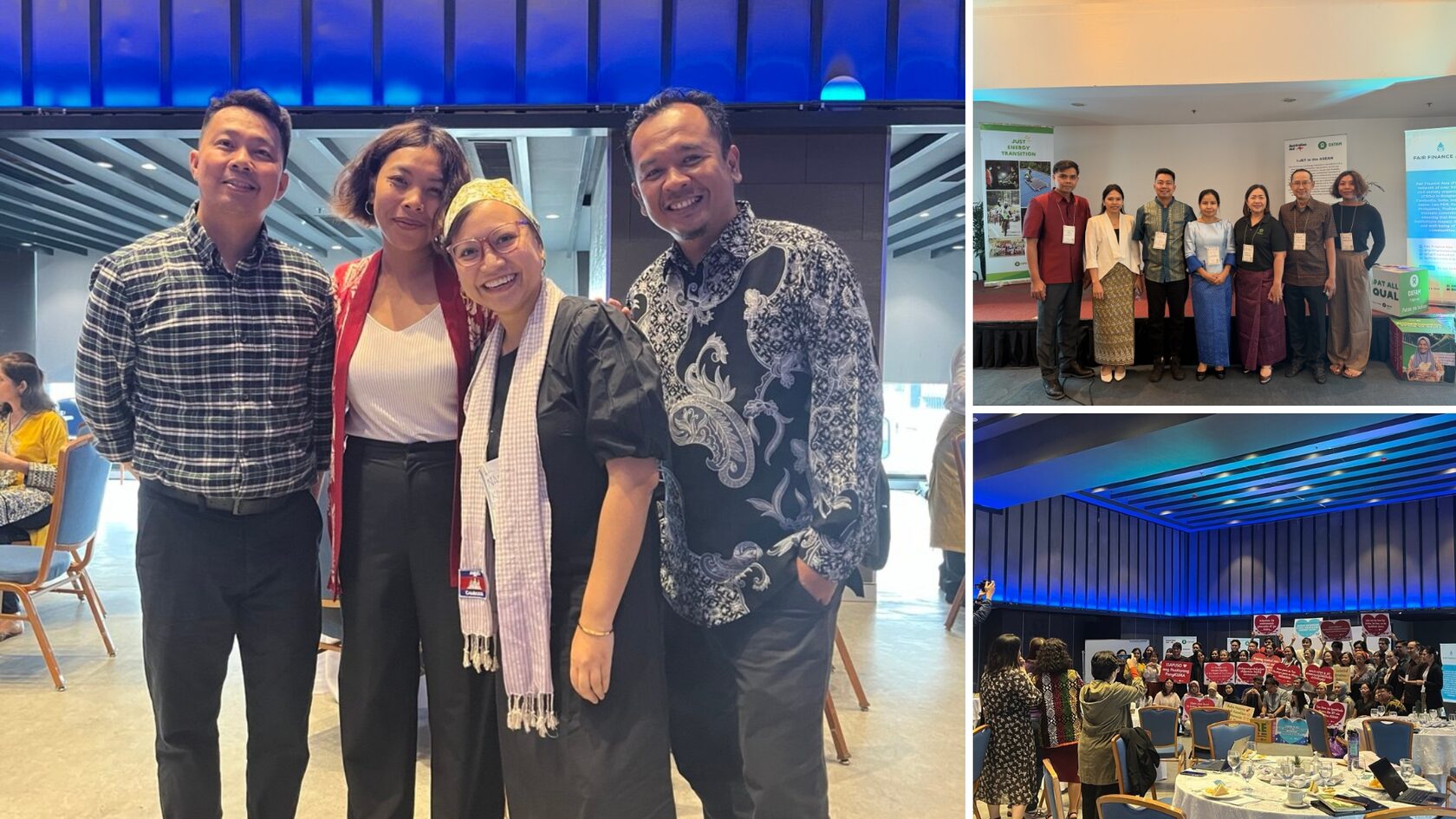
February is widely known as the month of love, but this Valentine's season, our Energy Policy Manager and Government Relations, Sokphalkun Out found something more meaningful to celebrate. She recently joined the 4th Southeast Asia Collaborative Convening of Civil Society Organizations on Just Energy Transition, held in the Philippines and organised by the Asia Network for People's Energy (ANPE), Fair Finance Asia (FFA), and the Influencing Just Transition in ASEAN (I-JET) Program.
The regional convening serves as a platform for Southeast Asia CSOs to share knowledge, experiences, and resources amid shrinking civic space and emerging Just Energy Transition (JET) challenges. Over three days, participants engaged with a high-level overview of COP30 outcomes, people-centered energy transition work by the IEA, youth-led campaigns, social accountability, GEDSI, and feminist JET frameworks — with each CSO applying these topics to their own country context through open dialogue and exercises.
Three key takeaways stood out for her.
First, climate change demands urgency, but a fast energy transition is not enough if it excludes the most vulnerable. Communities affected by climate change must be active participants in the transition, not passive recipients. As Abundio Edicio "Ed" G. dela Torre reminded us, this isn't just a Just Energy Transition — it's a "Just Empowering Transition." Technical knowledge should not gatekeep decision-making. Aligned with the ASEAN Plan of Action for Energy Cooperation (APAEC) 2026–2030, integrating GEDSI into energy planning is essential to ensure communities shape the solutions that affect their lives.
Second, JET is inherently complex and requires collaboration and transparency across institutions and borders. The convening surfaced real risks of "green colonisation" — where mining, finance, and consumption happen across different countries with unequal power dynamics. Protecting Indigenous rights and ensuring free, prior, and informed consent (FPIC) in critical mineral supply chains is non-negotiable.
Third, social accountability must move beyond policy text to ground-level reality. As highlighted by G-Watch, documenting what actually happens on the ground versus what is written in policy is essential to driving real change.
The convening concluded with a concrete action plan aligned with APAEC, and ANPE announced funding opportunities of $5k–$10k for CSOs to implement local activities.
This Valentine's season, the real celebration was found in collective action and shared courage — to demand a transition that empowers communities, protects children, and leaves no one behind.
The regional convening serves as a platform for Southeast Asia CSOs to share knowledge, experiences, and resources amid shrinking civic space and emerging Just Energy Transition (JET) challenges. Over three days, participants engaged with a high-level overview of COP30 outcomes, people-centered energy transition work by the IEA, youth-led campaigns, social accountability, GEDSI, and feminist JET frameworks — with each CSO applying these topics to their own country context through open dialogue and exercises.
Three key takeaways stood out for her.
First, climate change demands urgency, but a fast energy transition is not enough if it excludes the most vulnerable. Communities affected by climate change must be active participants in the transition, not passive recipients. As Abundio Edicio "Ed" G. dela Torre reminded us, this isn't just a Just Energy Transition — it's a "Just Empowering Transition." Technical knowledge should not gatekeep decision-making. Aligned with the ASEAN Plan of Action for Energy Cooperation (APAEC) 2026–2030, integrating GEDSI into energy planning is essential to ensure communities shape the solutions that affect their lives.
Second, JET is inherently complex and requires collaboration and transparency across institutions and borders. The convening surfaced real risks of "green colonisation" — where mining, finance, and consumption happen across different countries with unequal power dynamics. Protecting Indigenous rights and ensuring free, prior, and informed consent (FPIC) in critical mineral supply chains is non-negotiable.
Third, social accountability must move beyond policy text to ground-level reality. As highlighted by G-Watch, documenting what actually happens on the ground versus what is written in policy is essential to driving real change.
The convening concluded with a concrete action plan aligned with APAEC, and ANPE announced funding opportunities of $5k–$10k for CSOs to implement local activities.
This Valentine's season, the real celebration was found in collective action and shared courage — to demand a transition that empowers communities, protects children, and leaves no one behind.